
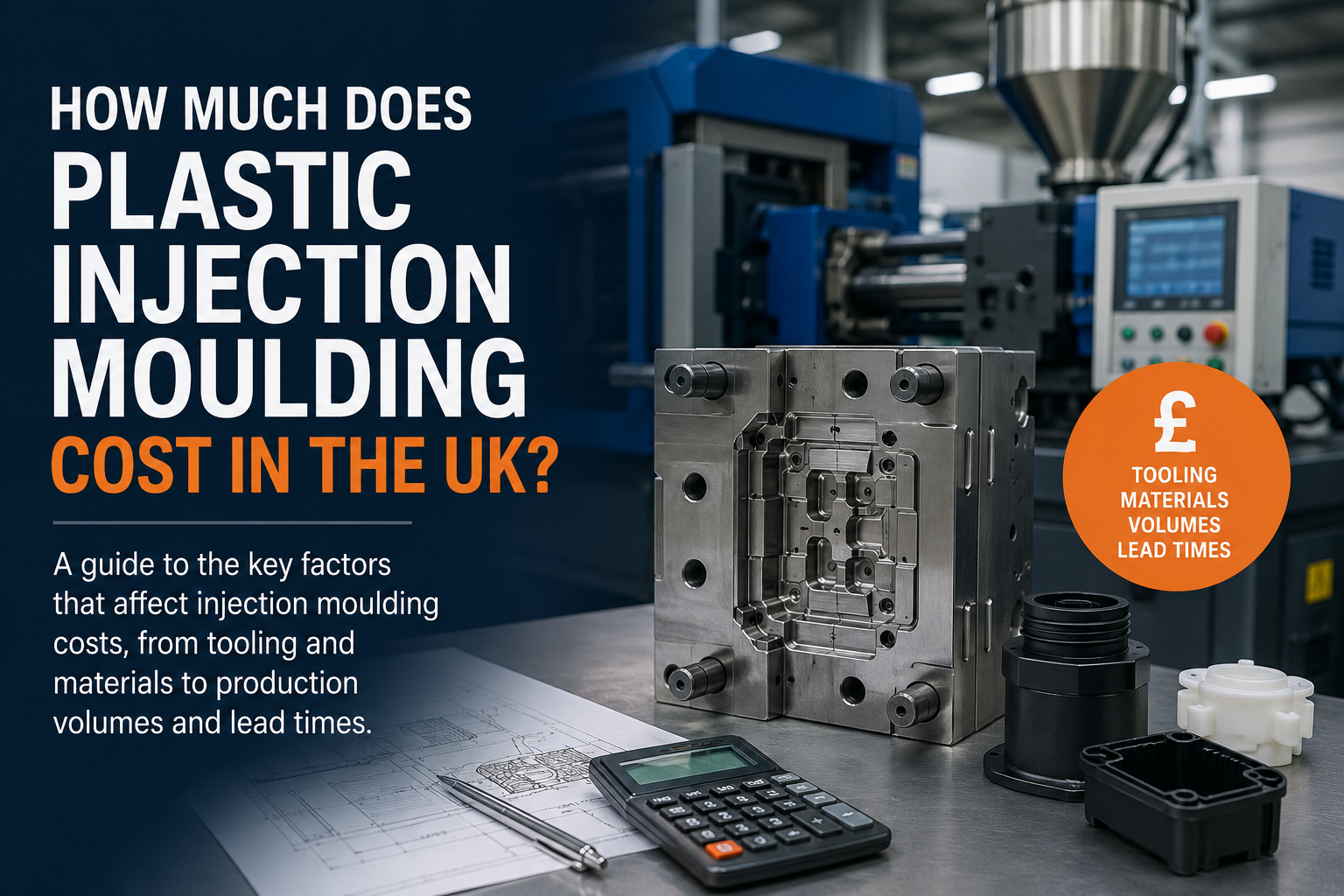
The cost of plastic injection moulding in the UK can range from a few thousand pounds for a relatively simple project to significantly more for complex, high-volume production. The final cost depends on the injection mould tool, component design, plastic material, order quantity, tolerances, finishing requirements and production timescale. Although initial tooling can represent a substantial investment, the cost per component can reduce considerably as production volumes increase.
For businesses considering injection moulding, understanding these costs is important when determining whether the process is commercially viable.
Unlike manufacturing methods where costs remain relatively consistent per component, injection moulding usually requires a larger upfront investment followed by potentially low unit costs during production.
This makes it particularly suitable for businesses that need to manufacture plastic components repeatedly and in larger quantities.
At Ertone Plastics, injection moulding projects can be developed from initial component requirements through to tooling and ongoing production.
What Determines the Cost of Plastic Injection Moulding?
There isn’t a standard price for producing an injection moulded component because every project has different requirements.
A simple plastic component produced in high quantities will have a very different cost structure from a technically complex component requiring specialist materials and extremely tight tolerances.
The main factors affecting the price include:
- Injection mould tooling
- Component size and complexity
- Choice of plastic material
- Production quantity
- Number of cavities within the mould
- Required tolerances
- Surface finish
- Secondary operations
- Quality requirements
- Lead times
Understanding each factor can help businesses identify opportunities to control costs without compromising the performance of the finished component.
How Much Does Injection Mould Tooling Cost?
Tooling is normally one of the largest initial costs associated with plastic injection moulding.
Before production can begin, a mould must be manufactured that creates the required component.
The cost of that tool can vary significantly depending on its complexity.
A relatively straightforward single-cavity mould for a simple component may be considerably cheaper than a multi-cavity tool designed to manufacture several technically complex parts during every production cycle.
Factors affecting tooling costs can include the size of the component, number of cavities, required tolerances, tool material, surface finish and complexity of the mould.
Features such as undercuts, threads and complex geometries may require additional tooling mechanisms, increasing both manufacturing complexity and cost.
However, focusing only on the cheapest possible tooling price can be a false economy.
A properly designed and manufactured mould can potentially be used to produce large quantities of components over an extended period. Tool quality should therefore be considered alongside the expected production volume and lifetime of the project.
How Component Design Affects Injection Moulding Costs
Product design can have a major influence on both tooling and manufacturing costs.
A component that appears simple on a CAD drawing may contain features that make injection moulding considerably more complicated.
Wall thickness is one example.
Maintaining appropriate and consistent wall thickness can help the plastic flow effectively through the mould and reduce the likelihood of manufacturing defects.
Unnecessarily thick sections can increase material usage and cooling times, potentially making every production cycle more expensive.
Complex undercuts can also increase tooling costs because additional mechanisms may be required to release the finished component from the mould.
Designing components specifically for the injection moulding process can therefore help control costs from the beginning.
Working with an experienced plastic injection moulding manufacturer during the design and development stages can help identify potential manufacturing issues before tooling is produced.
How Does Material Choice Affect the Price?
The type of plastic used to manufacture a component has a direct impact on its production cost.
There are many different polymers available for injection moulding, each providing different characteristics.
Depending on the application, a component may require particular levels of:
- Strength
- Flexibility
- Temperature resistance
- Chemical resistance
- Impact resistance
- Electrical properties
- UV resistance
- Surface appearance
Common thermoplastics can be relatively economical, while specialist engineering polymers can cost considerably more.
Material selection should therefore be based on what the component actually needs to achieve.
Specifying a high-performance polymer when a more economical material could provide the required performance may unnecessarily increase manufacturing costs across thousands of components.
However, choosing a cheaper material that cannot withstand the operating environment can create much larger costs through component failures, returns or redesigns.
The aim should be to find the most cost-effective material capable of meeting the required specification.
Production Volume and Cost Per Component
One of the biggest advantages of injection moulding is its potential to become increasingly cost-effective as production quantities rise.
Tooling represents an upfront investment.
If a mould costs £10,000 and is only used to produce 1,000 components, the tooling alone effectively represents £10 per component before material, machine time and other production costs are considered.
If the same mould produces 100,000 components, the tooling contribution falls to just 10p per component.
This simple example demonstrates why production volume is so important when assessing injection moulding costs.
Once tooling has been produced, automated injection moulding machines can manufacture components repeatedly with relatively short cycle times.
For long-term production programmes, this can result in highly competitive unit costs.
Can Multi-Cavity Tooling Reduce Costs?
For suitable high-volume projects, manufacturers may consider producing a mould containing multiple cavities.
Instead of producing one component during each injection cycle, the tool produces several simultaneously.
This can substantially increase production output.
However, multi-cavity tooling is generally more complicated and expensive to manufacture initially.
Businesses therefore need to consider whether the expected production quantities justify the additional tooling investment.
For a short production run, a simpler tool may provide better overall value.
For a component expected to be manufactured in very large quantities over several years, investing more in tooling could substantially reduce the long-term cost per part.
How Do Cycle Times Affect Injection Moulding Costs?
Cycle time is the amount of time required to complete each injection moulding cycle.
This typically includes closing the mould, injecting the plastic, cooling the component, opening the mould and ejecting the finished part.
Even small reductions in cycle time can become significant across large production quantities.
For example, reducing a manufacturing cycle by only a few seconds could save a substantial amount of machine time when hundreds of thousands of components are being produced.
Component design, material, wall thickness, mould design and cooling efficiency can all affect cycle times.
This is another reason why considering manufacturing efficiency during the initial design stage can have long-term financial benefits.
Do Secondary Operations Increase Costs?
Injection moulding may not always be the final manufacturing stage.
Depending on the product, components may require additional processes after moulding.
These could include:
- Assembly
- Printing
- Drilling
- Machining
- Welding
- Surface finishing
- Packaging
- Quality inspection
Every additional process adds time and potentially labour to the manufacturing operation.
When designing a component, businesses should therefore consider whether some features can be incorporated directly into the moulded part.
Reducing unnecessary secondary operations can help simplify production and lower the overall cost.
How Do Lead Times Affect Injection Moulding Projects?
Lead time is another important consideration when planning an injection moulding project.
Producing a new injection mould tool takes time, particularly when the component is complex or the tool requires multiple cavities or moving mechanisms.
The process may involve design review, tool manufacture, testing, sampling and modifications before full production begins.
Attempting to significantly accelerate this process can potentially increase costs.
Planning production requirements early gives manufacturers more flexibility and reduces the likelihood of expensive last-minute changes.
It can also allow time for components to be properly tested before moving into large-scale manufacturing.
UK Injection Moulding vs Overseas Manufacturing
When comparing injection moulding costs, businesses may be tempted to select an overseas supplier based purely on the initial quoted price.
However, the cheapest unit price does not necessarily represent the lowest total manufacturing cost.
Importing plastic components can introduce additional considerations such as:
- International shipping
- Import duties
- Longer lead times
- Minimum order quantities
- Currency fluctuations
- Communication delays
- Quality control
- Supply chain disruption
Working with a UK injection moulding company can make communication and project management considerably easier.
It may also allow businesses to respond more quickly when designs, production quantities or delivery requirements change.
Ertone has provided plastic injection moulding and manufacturing services from its Birmingham facility for decades, supporting businesses requiring reliable UK-based production.
How Can Businesses Reduce Injection Moulding Costs?
Reducing costs does not necessarily mean finding the cheapest manufacturer or using the least expensive plastic.
Often, the biggest savings come from improving the component and production process.
Businesses can potentially reduce injection moulding costs by:
- Simplifying component geometry where possible
- Maintaining appropriate wall thickness
- Avoiding unnecessary undercuts
- Selecting materials based on actual performance requirements
- Designing components specifically for injection moulding
- Increasing production quantities where commercially appropriate
- Reducing unnecessary secondary operations
- Planning production requirements in advance
- Optimising mould design
- Considering multi-cavity tooling for larger volumes
It is particularly important to consider these factors before tooling is manufactured.
Making a small design change to a CAD model can be relatively straightforward. Altering a completed injection mould tool can be considerably more complicated and expensive.
Is Plastic Injection Moulding Cost-Effective?
Plastic injection moulding can be extremely cost-effective when the component, tooling and production volume are appropriate for the process.
The initial tooling investment means it may not always be the best manufacturing method for extremely small quantities.
However, as production volumes increase, the ability to manufacture components quickly and repeatedly can result in a very competitive cost per unit.
The process can also deliver excellent repeatability, allowing manufacturers to produce large quantities of components to consistent specifications.
For businesses planning ongoing production, the important figure is therefore not simply the initial tooling price.
The total cost per component across the expected lifetime of the project provides a much more useful measure.
Get an Injection Moulding Quote
There is no single answer to how much plastic injection moulding costs because the price depends on the individual component and production requirements.
Tooling complexity, material selection, production quantities, cycle times and secondary operations can all influence the final cost.
Working with an experienced injection moulding company during the early stages of a project can help identify opportunities to simplify production, optimise tooling and reduce unnecessary manufacturing costs.
Based in Birmingham, Ertone Plastics provides UK plastic injection moulding services for businesses requiring reliable production of high-quality plastic components.
If you have a new or existing component that requires injection moulding, contact Ertone Plastics to discuss your requirements and request a quotation.