
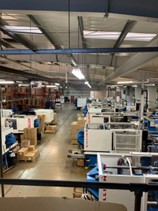
Injection moulding remains one of the most widely used manufacturing processes in Britain today, supporting industries ranging from automotive and medical to consumer goods, electronics, construction, and packaging. Its ability to produce consistent, high-quality components at scale makes it a cornerstone of modern UK manufacturing.
However, like any production method, it has both strengths and weaknesses. Understanding these helps businesses choose the most efficient route for their project and ensure their product meets cost, performance, and sustainability goals.
In this guide, we explore the advantages and disadvantages of injection moulding in detail, with a particular focus on how these factors impact UK-based manufacturers and product developers.
What Is Injection Moulding?
Injection moulding is a manufacturing process in which molten plastic is injected into a mould cavity, cooled, and ejected as a solid, finished part. It excels at producing large quantities of identical components with exceptional accuracy and repeatability.
From medical-grade enclosures to precision automotive clips and consumer product casings, injection moulding supports some of the UK’s most demanding sectors. Its versatility is matched only by its efficiency. Once tooling is in place, parts can be produced remarkably quickly with minimal waste.
Advantages of Injection Moulding
1. Ideal for High-Volume Production
One of the biggest advantages of injection moulding is its suitability for producing large quantities of identical parts. Once moulds are created, the cycle time per part can be incredibly fast often just seconds.
For UK manufacturers, this level of output means:
-
significant economies of scale
-
predictable lead times
-
consistent production for long-term contracts
Businesses looking to produce thousands or millions of parts benefit greatly from this efficiency.
2. Excellent Consistency and Repeatability
Injection moulding is highly automated, delivering precise control over temperature, pressure, and timing. This results in:
-
highly accurate parts
-
tight tolerances
-
minimal variation between batches
For industries like automotive, medical, and aerospace, where British manufacturers must meet strict regulatory standards this repeatability is essential.
3. Low Waste and High Material Efficiency
The process is designed to produce minimal scrap. Any excess material from runners or sprues can often be reground and reused, making it a highly material-efficient option.
This is particularly important as UK manufacturers increasingly prioritise sustainability, waste reduction, and compliance with environmental standards.
4. Wide Range of Materials and Finishes
Injection moulding supports thousands of polymer grades, including:
-
ABS
-
Polypropylene (PP)
-
Polycarbonate (PC)
-
Nylon (PA)
-
High-performance engineering plastics
It also supports additives for UV protection, flame retardancy, colour matching, and improved strength.
Surface finishing options include:
-
gloss, matte, or textured surfaces
-
in-mould decoration
-
overmoulding and multi-shot moulding
This variety gives manufacturers tremendous design flexibility.
5. Highly Detailed and Complex Geometries
Injection moulding can produce intricate shapes that would be difficult or impossible to produce using other methods. Features such as internal structures, threads, ribs, clips, and snap-fits can be moulded directly into the part.
This allows UK designers to integrate multiple features into a single moulded component, reducing assembly steps and overall cost.
6. Cost-Effective Long-Term Production
Although tooling represents a significant initial investment, once it is created, the per-unit cost drops dramatically. For long-running production lines or products with stable demand, injection moulding becomes one of the most cost-effective options available.
Disadvantages of Injection Moulding
1. High Initial Tooling Costs
The most significant drawback is the upfront cost of mould design and manufacture. Even for relatively simple parts, UK tooling prices can be substantial. More complex moulds with multiple cavities, moving parts, or advanced cooling channels increase this cost further.
However, these costs are often justified by the long-term savings associated with high-volume production.
2. Longer Lead Times During Tooling Stage
While the production phase is extremely fast, creating the mould takes time. In the UK, tooling lead times often range from several weeks to a few months depending on complexity. This can delay product launches if not factored into project planning.
For highly time-sensitive projects, rapid prototyping or 3D printing may be used initially before moving to full tooling.
3. Not Always Cost-Effective for Low-Volume Runs
Because of the upfront tooling investment, injection moulding is less suited to small production batches. For start-ups, bespoke projects, or highly specialised components, the cost per part can become impractical at low quantities.
In such cases, processes like vacuum forming, CNC machining, urethane casting, or additive manufacturing may offer better value.
4. Design Changes Become Expensive
Once a mould has been manufactured, altering it can be costly and time-consuming. Significant design changes may require:
-
reworking the tool
-
modifying cavities
-
or commissioning a completely new mould
For this reason, thorough prototyping and design validation are essential before committing to tooling.
5. Environmental Considerations
Although injection moulding can be highly material-efficient, it still relies heavily on plastics. While many UK manufacturers now use recycled polymers, the sustainability of a moulded product depends on:
-
material choice
-
recyclability
-
product lifespan
-
end-of-life recovery
Fortunately, increasing demand for circular manufacturing is pushing the industry to adopt more environmentally responsible materials and processes.
Injection Moulding in the UK: Additional Considerations
A Strong Domestic Manufacturing Base
The UK is home to a robust ecosystem of injection moulding specialists serving both domestic and global markets. British moulders are known for:
-
precision engineering
-
quality assurance
-
compliance with rigorous standards
-
traceability and reliable supply chains
Working with a UK-based partner also offers reduced risk, faster communication, and simplified logistics.
Focus on Sustainability and Innovation
From material innovation to energy-efficient machinery, the UK injection moulding sector continues to evolve. Many manufacturers operate ISO-certified facilities, prioritise environmental management, and embrace advanced automation to reduce waste and energy consumption.
Support for Prototyping and Design
Modern UK moulders often provide a full end-to-end service, including:
-
CAD design
-
tooling design
-
prototyping
-
material selection
-
pre-production sampling
This helps ensure products reach market faster and with fewer risk factors.
Is Injection Moulding the Right Choice for Your Project?
To decide whether injection moulding is the correct manufacturing method, consider the following:
-
Do you expect high-volume or long-term production?
-
Is consistency and tight tolerance essential?
-
Is the product likely to evolve or change over time?
-
Do you have budget allocated for tooling?
-
What material properties does your application require?
For many products, injection moulding offers the ideal solution, combining quality, speed, and long-term cost efficiency. But for others, alternative processes may be more appropriate.
Final Thoughts
Understanding the full advantages and disadvantages of injection moulding helps businesses make informed decisions and avoid unnecessary costs or delays. While injection moulding offers outstanding repeatability, material flexibility, and scale, it also requires careful planning due to tooling costs and design constraints.
If your business is exploring injection moulding in the UK, partnering with a knowledgeable and experienced manufacturer is key to achieving reliable, cost-effective, and high-quality results.
